
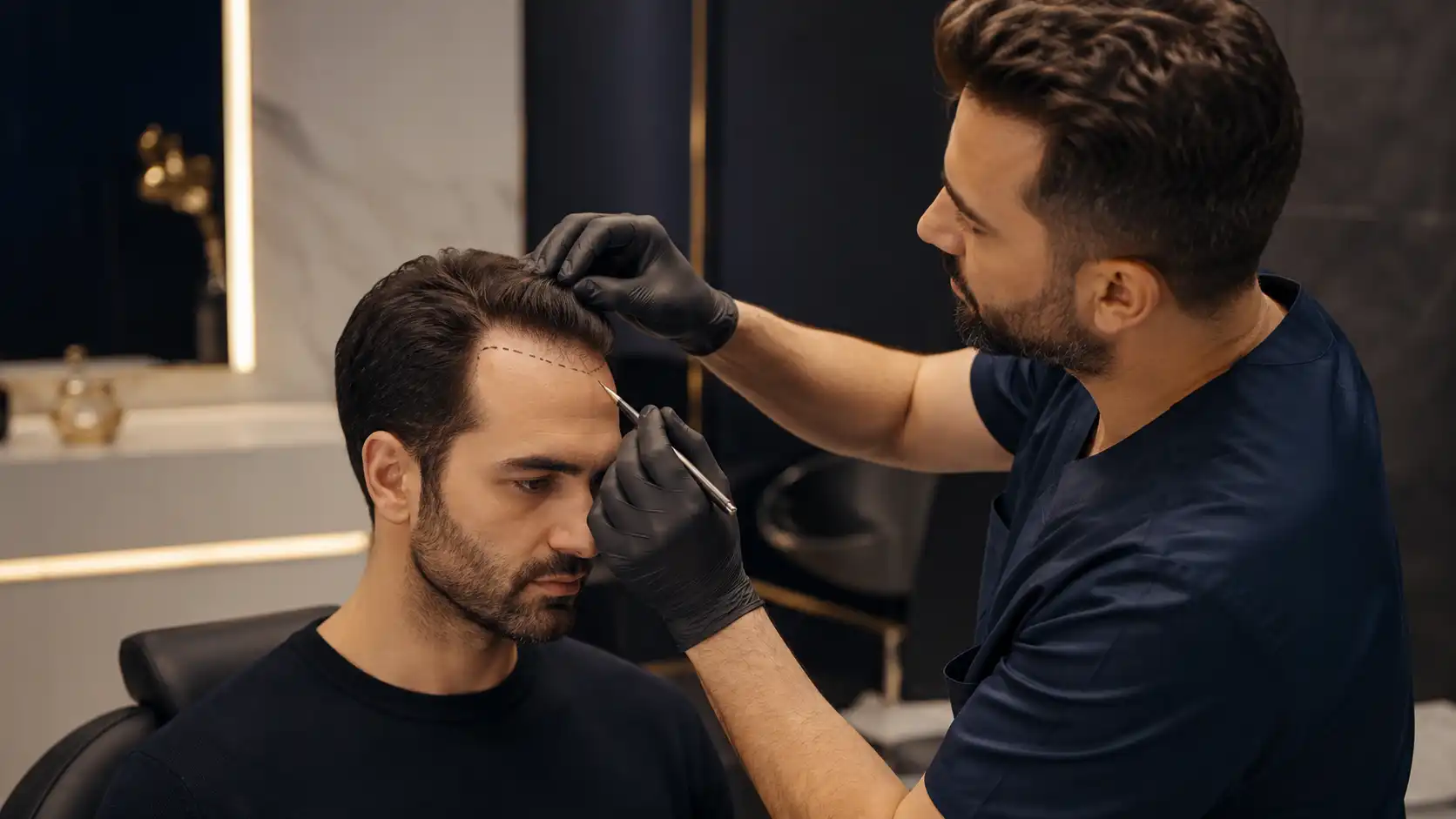
What is FUE Hair Transplant?
FUE hair transplantation is a modern method where individual hair follicles are gently extracted from the donor area and implanted into thinning or bald areas. At HaarLab, FUE is individually planned so that hairline, density and growth direction look natural.
What Is a FUE Hair Transplant?
FUE hair transplant is one of the most modern and commonly preferred hair restoration methods today. FUE stands for “Follicular Unit Extraction”. In this technique, individual hair follicles are extracted from the donor area and implanted into thinning or bald areas with a natural growth direction.
The donor area is usually located at the back and sides of the head, as these hair follicles are generally more resistant to genetic hair loss.
At HaarLab, FUE hair transplantation focuses not only on the technique itself, but also on aesthetic planning. Hairline design, facial proportions, age, hair structure, donor capacity and desired density are carefully evaluated to create a personalized treatment plan.
Who Is a FUE Hair Transplant Suitable For?
FUE hair transplantation may be suitable for people experiencing receding hairline, temple hair loss, crown thinning, loss of frontal density or general hair thinning. However, the most suitable method should always be determined after a detailed hair analysis.
Common Treatment Areas for FUE Hair Transplant
- Receding hairline and temple areas
- Frontal hair thinning
- Crown area hair loss
- Natural hairline reconstruction
- Correction of previous hair transplant results
- Targeted density improvement in selected areas
To find out whether FUE is suitable for you, you can request a free hair analysis. During the assessment, the frontal area, sides, crown and donor area are evaluated to estimate a realistic graft number.
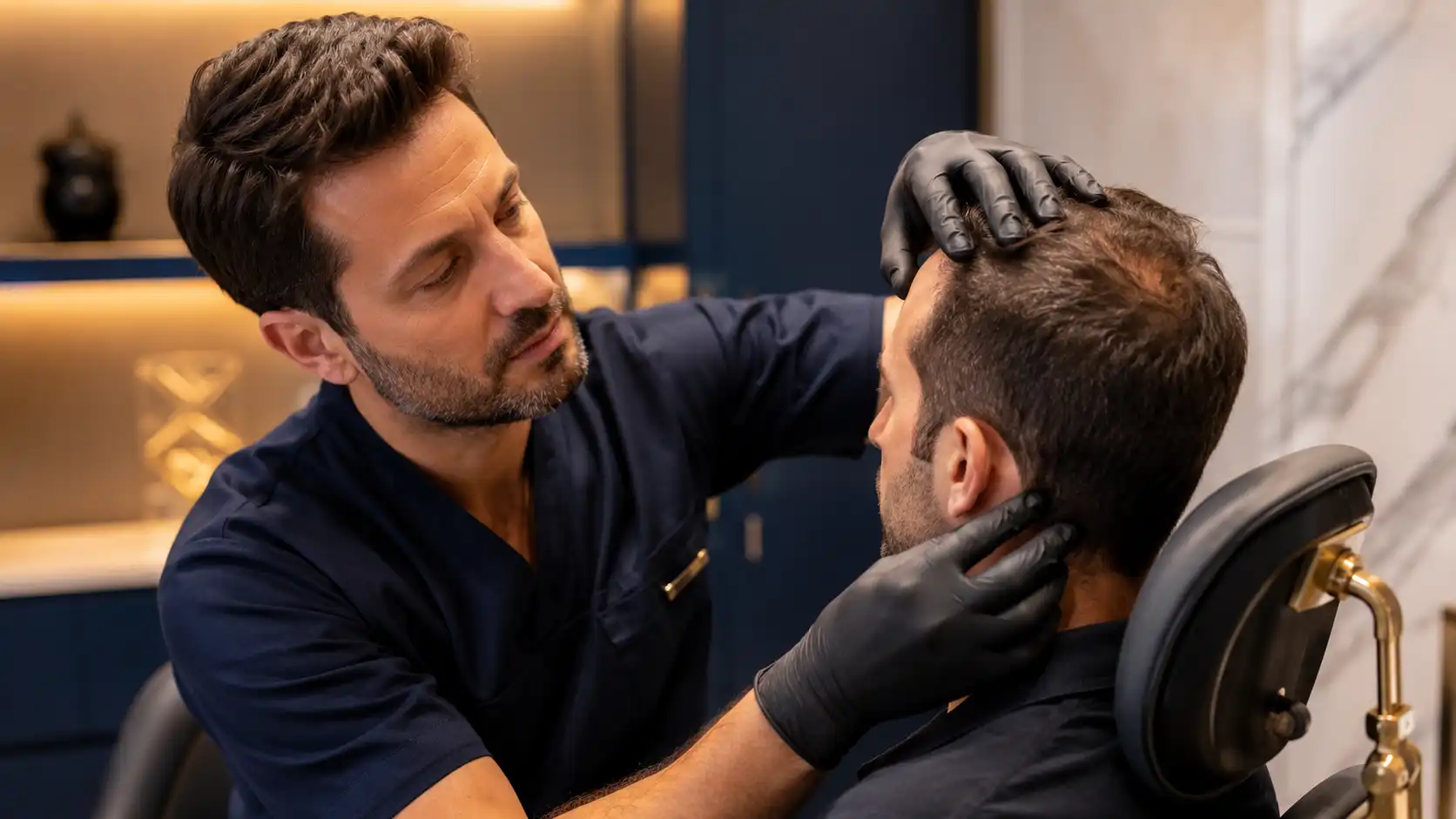
How Does a FUE Hair Transplant Work?
The FUE hair transplant process starts with a detailed analysis and personalized planning. At HaarLab, the goal is not simply to transplant hair, but to achieve a natural-looking, aesthetically balanced and long-term result.
1. Hair Analysis and Consultation
In the first step, the hair loss pattern, donor area quality, hair structure and patient expectations are evaluated. Not every patient needs the same graft number or the same hairline design. That is why realistic and personalized planning is essential.
2. Natural Hairline Planning
One of the most important steps in FUE hair transplantation is hairline design. A hairline that is too low, too straight or not suitable for the face can look unnatural. At HaarLab, the hairline is planned according to age, facial proportions, existing hair structure and long-term hair loss risk.
3. Extraction of Hair Follicles
With the FUE technique, hair follicles are extracted individually from the donor area. A balanced extraction is important to protect the donor area and avoid visible thinning at the back of the head.
4. Implantation of Grafts
The extracted grafts are implanted into the planned areas according to natural angle, direction and density. Especially in the frontal area, precision is essential for a soft and natural-looking result.
5. Aftercare
After the procedure, patients receive detailed aftercare instructions. The first days and weeks are important for proper healing. The final result does not appear immediately; new hair growth develops gradually over several months.
Advantages of FUE Hair Transplantation
- Modern and minimally invasive hair restoration technique
- Individual extraction of hair follicles
- No long linear scar as seen in older methods
- Suitable for different hair loss patterns
- Allows personalized natural hairline design
- Can be combined with PRP hair treatment and aftercare concepts
FUE or DHI – Which Method Is Better?
FUE and DHI hair transplant are often compared. However, there is no single best method for every patient. FUE mainly refers to the extraction of individual hair follicles, while DHI is more related to the implantation technique.
For some patients, FUE may be more suitable, while others may benefit from DHI or Sapphire FUE hair transplant. The right choice depends on hair status, donor area quality, target density and personal goals.
FUE Hair Transplant Cost
The cost of a FUE hair transplant depends on several factors, including the required number of grafts, the treatment method, the size of the treatment area, donor area quality and the individual treatment plan. For this reason, a reliable price estimate can only be provided after an analysis.
At HaarLab, patients receive a realistic evaluation before the procedure. For more information, visit our hair transplant prices page or request a free consultation.
FUE Hair Transplant in Germany: HaarLab Clinic Locations
HaarLab offers hair transplant consultation and treatment planning across different locations in Germany and Europe. Patients can receive hair analysis, preliminary assessment and personalized planning through our Mannheim, Frankfurt, Düsseldorf and Rijswijk locations.
- HaarLab Mannheim Hair Transplant Clinic
- HaarLab Düsseldorf Hair Transplant Clinic
- HaarLab Frankfurt Hair Transplant Clinic
- Hair Transplant Mannheim
FUE Hair Transplant Before and After
A natural FUE hair transplant result depends on accurate planning, correct graft placement and a patient healing process. After the procedure, temporary shedding may occur before new hair starts to grow gradually.
You can view real result examples on our hair transplant before and after page.
Start Your Free FUE Hair Analysis
Send us photos of your frontal area, sides, crown and donor area. Our team will evaluate the suitable method, estimated graft number and realistic result planning for you.
Request Free AnalysisFrequently Asked Questions About FUE Hair Transplant
Is FUE hair transplantation suitable for everyone?
No. Donor area quality, hair loss pattern, hair structure and expectations must be evaluated before deciding on the treatment. A detailed hair analysis is necessary.
How many grafts do I need?
The required number of grafts depends on the level of hair loss, the size of the treatment area and the desired density. Receding temples usually require fewer grafts than a larger crown or top-area restoration.
Does a FUE hair transplant look natural?
Yes, if the hairline, growth direction, density and graft distribution are planned correctly. At HaarLab, the focus is always on natural-looking and realistic results.
When will I see the final result?
The result develops gradually. Temporary shedding may occur in the first months. Visible improvement usually begins after several months, while the final result takes time.
Is aftercare important after FUE hair transplantation?
Yes. The first days and weeks are important for healing. Following the aftercare instructions supports a healthy recovery and helps protect the transplanted grafts.
FAQ
Häufige Fragen
Für wen ist diese Behandlung geeignet?
Das hängt von Ihrer Haarsituation, dem Spenderbereich und Ihren Zielen ab. Eine Analyse gibt eine erste Orientierung.
Wie läuft die erste Beratung ab?
Sie senden uns Fotos Ihrer Haare. Danach erhalten Sie eine erste Einschätzung und können einen Beratungstermin vereinbaren.
Welche Methode passt zu mir?
FUE, DHI oder Saphir FUE werden je nach Haarsituation, Haarlinie und gewünschter Dichte individuell bewertet.