
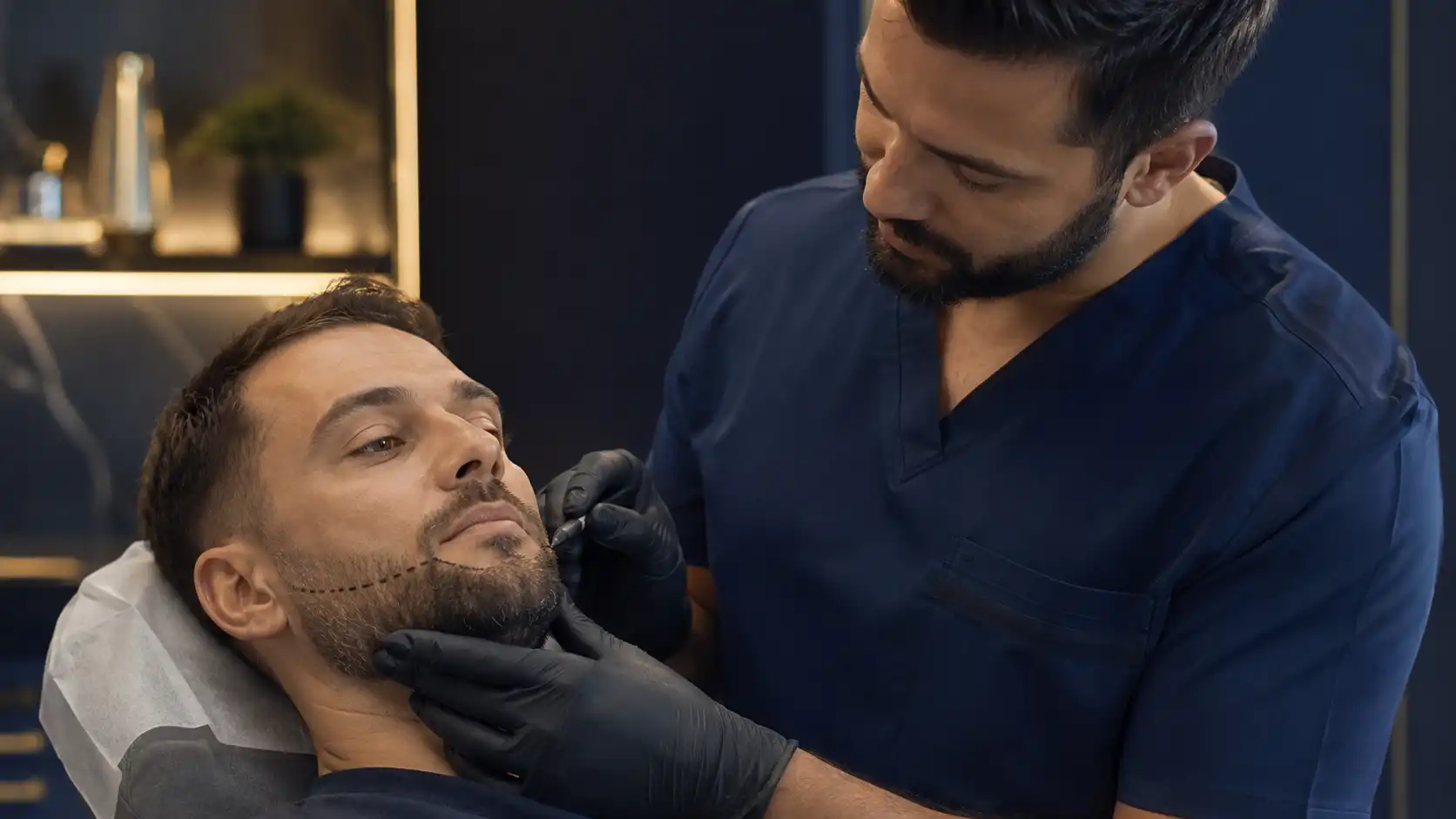
Who is a Good Candidate for Beard Transplant?
Beard transplant is suitable for men with patchy beards, uneven contours or low beard density. HaarLab plans beard transplants according to face shape, beard growth and desired contour.
What Is a Beard Transplant?
A beard transplant is an aesthetic procedure in which hair follicles are extracted from the donor area and implanted into patchy, weak or uneven beard areas. The goal is to create a denser, more balanced and natural-looking beard appearance.
Many men seek stronger beard contours, increased cheek density, fuller chin coverage or smoother transitions between moustache, beard and sideburns. At HaarLab, every beard transplant procedure is individually planned according to facial structure and desired beard style.
Who Is a Beard Transplant Suitable For?
Beard transplantation may be suitable for men with patchy beard growth, weak beard density, asymmetrical beard areas or visible scars within the beard region.
Common Reasons for Beard Transplantation
- Patchy cheek beard areas
- Weak chin beard growth
- Irregular beard contours
- Missing connection between beard zones
- Scars within the beard area
- Desire for a fuller beard appearance
The suitability of a beard transplant mainly depends on donor area quality and hair structure. Initial evaluation requires photos of the beard area and donor region.
Why Beard Planning Is So Important
A natural beard does not grow with the same density in every facial area. Hair angle, direction and density vary across the face. That is why beard transplantation must always be individually planned.
Beard Contour and Facial Shape
The beard contour strongly affects facial appearance. Overly sharp or unnatural lines may create artificial results. At HaarLab, beard contours are designed according to facial structure and natural beard growth patterns.
Density and Transitions
A successful beard transplant requires natural transitions between cheeks, sideburns and chin areas rather than equal density everywhere.
How Does a Beard Transplant Work?
The beard transplant process begins with a detailed analysis. The target areas and donor area quality are evaluated before creating a personalized beard design.
1. Digital Beard Analysis
Photos from multiple angles and donor area images are reviewed to estimate the required graft number and treatment plan.
2. Beard Design and Contour Planning
For a natural result, beard shape, density and transitions are carefully planned according to facial proportions.
3. Extraction of Hair Follicles
Hair follicles are usually extracted from the back of the scalp. Balanced extraction is important to maintain the natural donor area appearance.
4. Implantation Into the Beard Area
The grafts are implanted according to natural hair angles and directions. This stage is critical for realistic-looking results.
Advantages of Beard Transplantation
- Density enhancement for patchy beard areas
- Improved beard contour definition
- Natural transitions between beard zones
- Personalized planning according to facial shape
- Scar camouflage within the beard area
- Long-term aesthetic improvement
Beard Transplant Cost
The cost of beard transplantation depends on the treatment area size, required graft number and complexity of contour planning.
Smaller patch corrections require fewer grafts, while full beard density enhancement may need more extensive planning. A realistic cost estimate can only be provided after analysis.
Beard Transplant in Germany – HaarLab Clinics
HaarLab provides hair and beard transplant consultation across Mannheim, Frankfurt, Düsseldorf and Rijswijk.
Start Your Free Beard Analysis
Send us photos of your beard area and receive a free evaluation regarding suitable treatment options and realistic beard planning.
Request Free AnalysisFrequently Asked Questions About Beard Transplant
Can a beard transplant create a full beard?
This depends on donor area capacity and hair structure. In many cases, significant density improvement is possible.
Do transplanted beard hairs look natural?
Yes. Natural results depend on proper angle, direction, density and contour planning.
Where do the donor hairs come from?
The grafts are usually extracted from the back and sides of the scalp.
Can small beard gaps also be treated?
Yes. Smaller patchy areas can also be successfully treated if the donor area is suitable.
FAQ
Häufige Fragen
Für wen ist diese Behandlung geeignet?
Das hängt von Ihrer Haarsituation, dem Spenderbereich und Ihren Zielen ab. Eine Analyse gibt eine erste Orientierung.
Wie läuft die erste Beratung ab?
Sie senden uns Fotos Ihrer Haare. Danach erhalten Sie eine erste Einschätzung und können einen Beratungstermin vereinbaren.
Welche Methode passt zu mir?
FUE, DHI oder Saphir FUE werden je nach Haarsituation, Haarlinie und gewünschter Dichte individuell bewertet.